The Swedish Chef defeats the Borg Queen and assimilates the Borg in turn.
Be seeing you…
The Swedish Chef defeats the Borg Queen and assimilates the Borg in turn.
Having joined the Poetics and Linguistics Association, I was very excited to get my first set of journals. Sadly, when the envelope arrived, it was empty.
Here’s what the envelope looked like:


I am about a week into my first foray into kriegsspielling, and so far I have to confess that I am a bit dismayed by the experience. At least the experience of a play-by-post game. Part of the problem for me is that in attempting to increase the realism of the simulation, they have taken one of the things that I found appealing: playing with others.
Instead, the experience of commanding a company — I am in a make-believe WW2-era scenario pitting blue against red — is about being on your own and only able to interact with fellow players by dispatches. This works in terms of realism, but it’s not the camaraderie of kibitzing about the next move that I anticipated.
Instead, this feels more like a number of solo RPG games I have been playing where one does a great deal of writing and occasionally rolls some dice in order to determine the development or outcome of a particular moment (a scene). I like playing these games, and I like writing. But I don’t really need more of it: I do have some solo war-games which could, in a pinch, offer me much the same (lack of) interaction as an IKS play-by-post game.
All that noted, there do appear to be other games where there is greater player-to-player interaction. For now, at least in my newbie game, it seems like it’s mostly player-to-moderator-to-player interaction which while more realistic is far less fun.
This is all fascinating, and I’m just capturing impressions here as I continue to explore what IKS has to offer.
One of the outcomes of the success of the narrative games course was my own renewed interest in all kinds of games. In particular, I still have a number of the board games from when I was a kid. The ones I played the most were from Avalon Hill, but I was also quite fond of the games by Yaquinto. (And while AH features in gamer nostalgia, I have yet to see anything about Yaquinto. No love for Marine 2002: A Game of the First Lunar War?)
In addition to a number of solo games that are driven by writing—Starforged, Loner, Star Trek: Captain’s Log—I have also picked up a number of solo wargames. So far, the rules have been a little daunting. (How I played Squad Leader, I don’t know, but I think the designers of that game did a pretty good job of giving you the minimal viable rules and then slowly adding rules as you worked your way through scenarios.)
To shake off the rust, I decided to join the International Kriegsspiel Society, where I have been lurking for the past few months. And then, with the holidays looming, I decided to join a play-by-post game—which is actually done on Discord. So far, I’ve managed to miss my first turn deadline by a few hours and have my ability to lead my company questioned, but I think I’m back on track. I like the vignetted maps that the moderator posts into my “command” channel.


The customary first step in learning any new coding language is to have it output the phrase “Hello world!” (I’ve seen a lot of variation in the punctuation.) In Python, that is as simple as
print("Hello world!")
Being someone who has long read, and watched, science fiction, I prefer Obi Wan Kenobi’s “Hello there,” the character’s first words in the film. He walks to where Luke Skywalker lies having been struck down by one of the sand people, squats, throws back his hood when R2D2 makes a noise, looks up and says “Hello there.”

It’s on Youtube.
There is a steady stream of books I would like to read, and I really should make time to read. Both David Golumbia’s Cyberlibertarianism and Blix and Glimmer’s Why We Fear AI strike me as interesting. My guess is that Golumbia will have worked newer ground, but that does not mean Blix and Glimmer isn’t worth a read.


It is hard to account for the delight I continue to experience revisiting a single moment from a football (soccer) game, but yet this moment when a young Aston Villa fan flips off the full back for Crystal Palace does just that. I think it must be the cherubimesque face of the boy and his complete commitment to the flipping off with both hands that reflects his outrage at being waved at by an opposing player. It happened in the blink of an eye, but someone somewhere captured the moment. Despite it being a TikTok of a phone recording of a television screen, I am grateful.
Because I have taught classes where we have either focused on the earlier phases of AI, recurrent neural networks and transformers, where I have in fact allowed students (in later classes) to use AI to draft code, I am often asked about AI in education more generally. The honest answer is: I have no idea. My small corner of higher education deals mostly with both qualitative and quantitative analyses of certains types of vernacular discourse—e.g., legends, conspiracy theories, memes. And the classes I teach are either oriented toward those forms, or toward forms, like narrative games, that might enjoy something with my expertise and interest to make an interesting contribution to someone’s education.
What I hear from faculty, however, is mostly anxiety (but also sometimes exuberance) over an escalation in technology usage and dependence that reminds me of the subplot in Real Genius involving the math class. When the protagonist first enters the classroom, it is the traditional scene we imagine: professor upfront and students in desks. The next time we glimpse the classroom, a few students have been replaced with recording devices. The next time the professor walks into the room, it’s a sea of recording devices. In the final tableau, our protagonist walks into the room with nothing but recording devices on student desks and a player — in this case a reel-to-reel tape deck! — delivering the lecture.
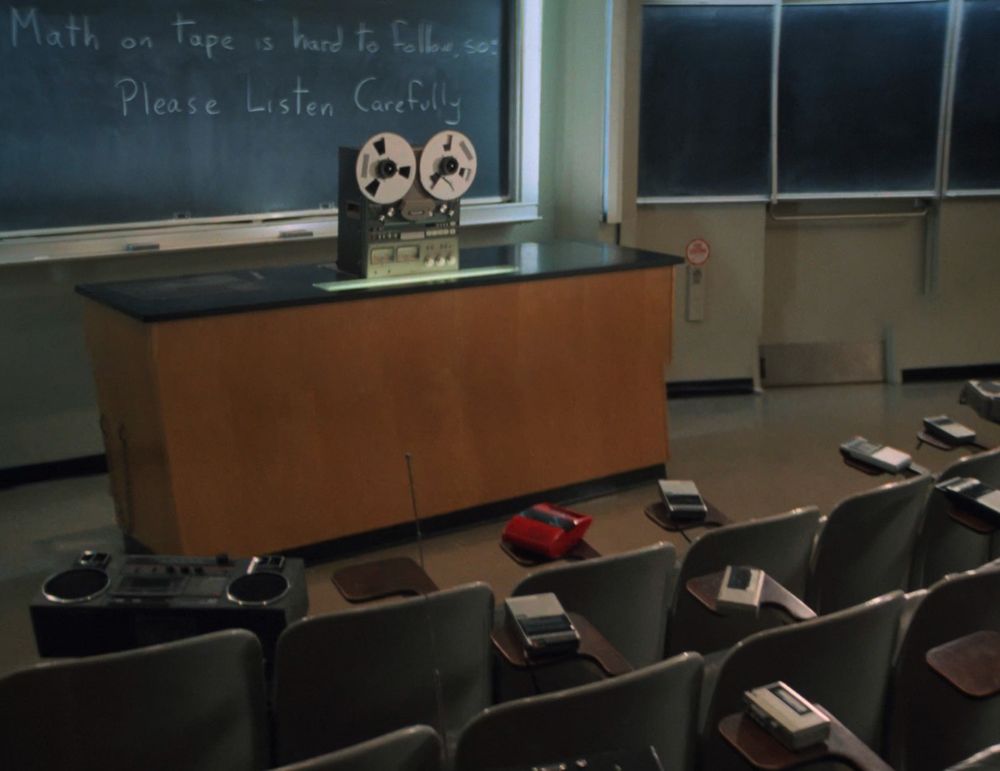
The protagonist stands, befuddled, in an aisle, and the audience enjoys a chuckle from the irony of the escalation of technology such that both professors and students have been replaced by devices.
Now, with AI, the fear isn’t that students won’t come to class but that they will submit work not generated by themselves but by one of the LLMs. This in turn has led to some of the plagiarism detection services adding the ability to detect AI-generated text as part of what they can do, or professors hand-checking or believeing that they can simply “just tell” when a written assignment has been generated by AI.
There are ways around this, of course. In my text analytics course I allowed students to use AI to generate code, warning them they would need to revise it for the particular nature of the assignments, but that they should generate the documentation themselves: the course used Jupyter notebooks and I required both # comments in the code blocks but also plain language descriptions and explanations in the text blocks. The way I reinforced the importance of understanding the concepts and methods behind the code was by requiring the final assignment to be hand-written in class with no devices available. Students who had taken the documentation dimension of the assignments seriously and done the work did well. Those who had relied on AI for too much did not do so well.
In other classes, I tend to encourage, or require where appropriate, that students bring in printouts of the essays we will discuss in class. I also encourage taking notes by hand. In the case of the latter, there has been more than enough work done to establish how much better note-taking by hand is in terms of processing material and making it your own.
I’m also lucky to teach classes, like the one on narrative games, where students want to do the work for themselves. It’s their chance to be creative and to make something. To encourage this, I tend to start with a tabletop role playing game (TTRPG) which they can develop entirely by hand.
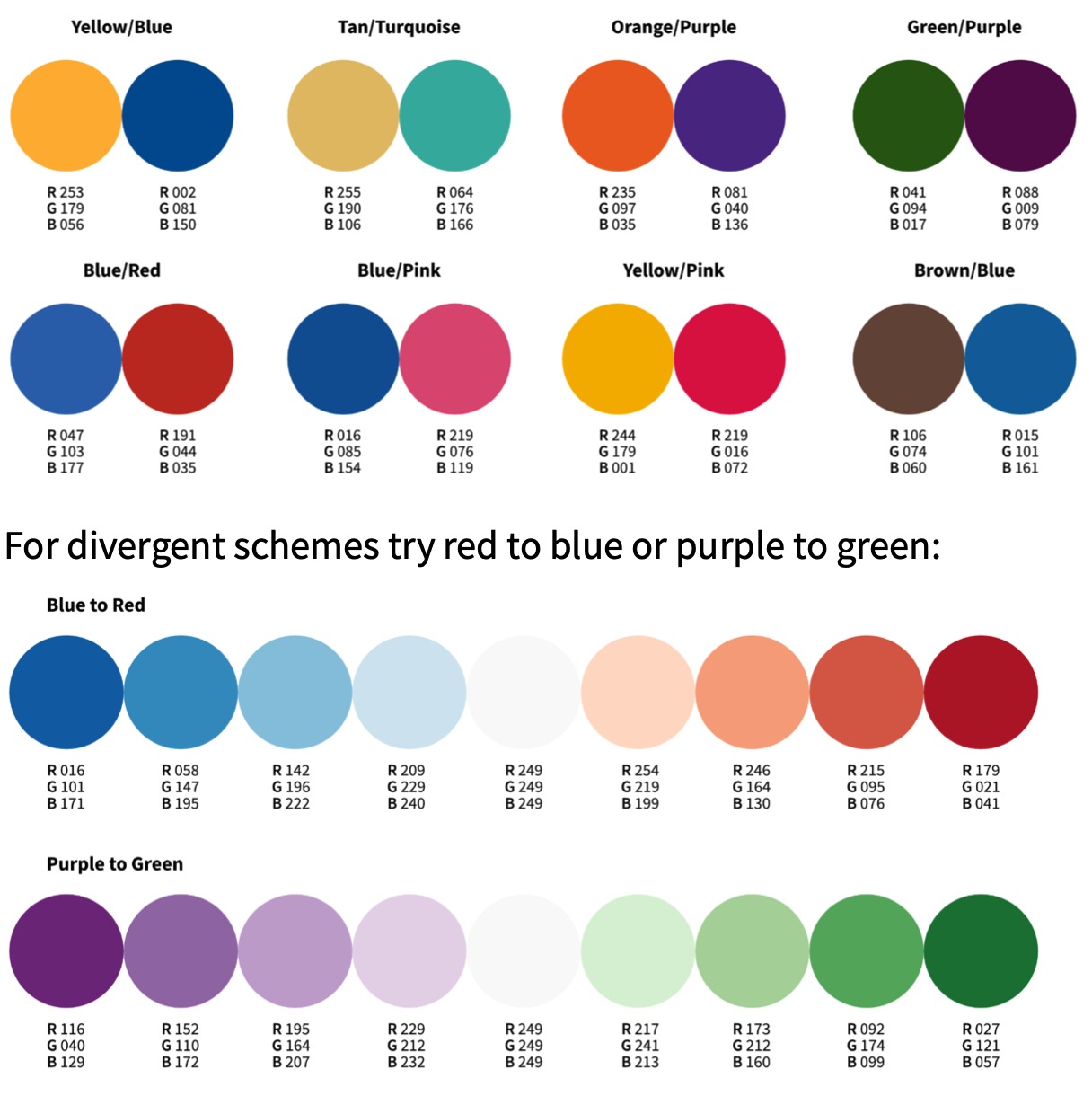
I was very fond of my slides that used a very intense pink as part of their design, but I realized that the pink was a problem for the most common form of color blindness, deuteranopia (red blindness). A little digging turned up this NCEAS Science Communication. I was most interested in the pairings, and so this diagram from the first page is the one I found most useful: